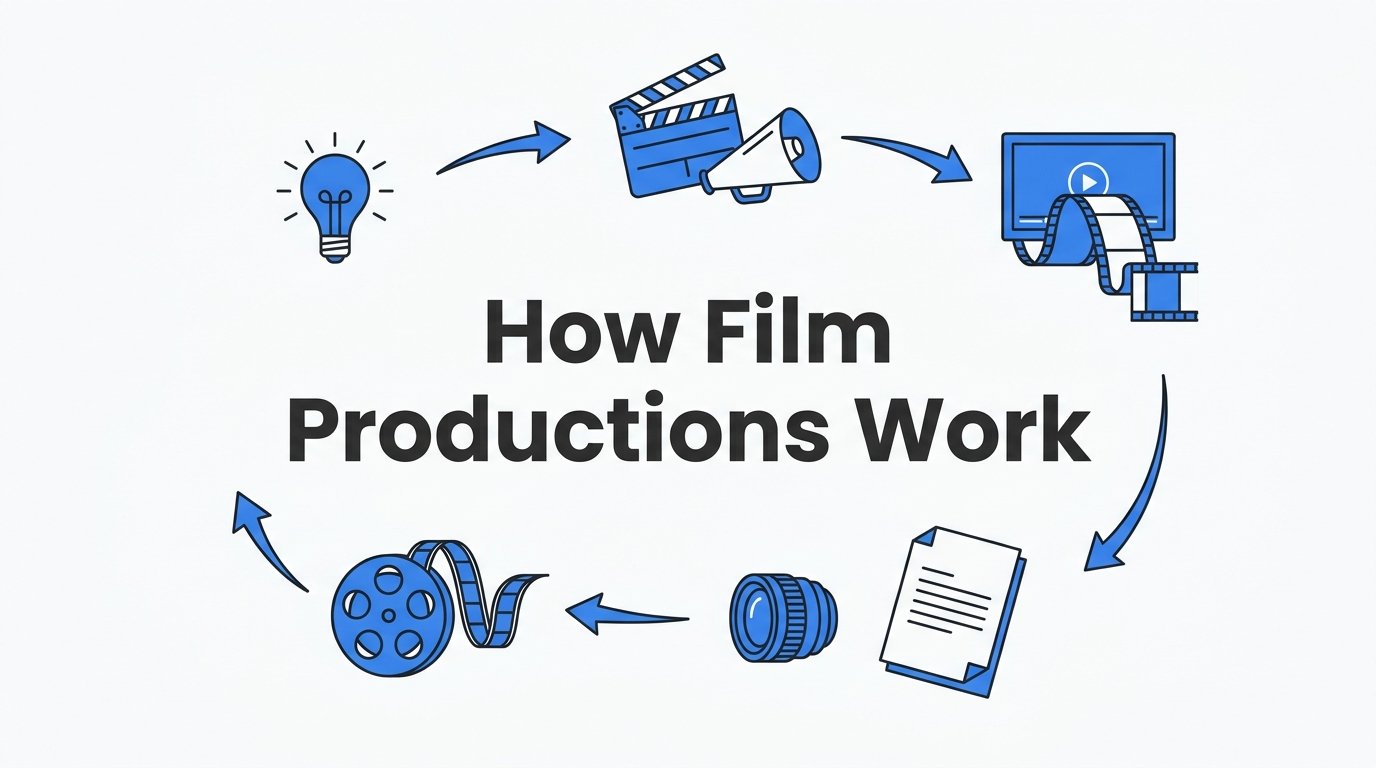
How Film Productions Work: From First Idea to Finished Film
A film production is a temporary company that forms to turn a script into a finished movie and dissolves once the film is delivered. This guide explains how film productions work across five stages, from development through release, showing who does what, how team size and budget focus change, and why so much planning happens before cameras roll.
A film production is a temporary company. It forms to turn a script into a finished movie, hires dozens or hundreds of people for a few months, and dissolves when the film is delivered. How film productions work comes down to five stages, each with a different team size, a different budget focus, and a different question to answer before moving on.
Most newcomers assume the action happens on set. In reality, the shoot is the most expensive stretch of the process, which is exactly why so much planning happens before it and so much finishing happens after it. Following one imaginary project through each stage shows who does what, when, and why.
The Five Stages Every Film Moves Through
Almost every film, from a student short to a studio release, passes through the same sequence. What differs is scale, not order.
- Development: the idea becomes a script with a plan to pay for it. It ends with a workable script, the rights secured, and financing committed or close to it.
- Pre-production: the film is planned in detail. It ends with a shooting schedule, a budget, a cast, a crew, locations, and permits and insurance in place.
- Production: the film is shot. It ends with all the planned footage and sound recorded, known as a wrap.
- Post-production: the footage becomes a film through editing, sound, music, color, and effects. It ends with a locked picture and finished audio.
- Distribution: the film reaches an audience through festivals, sales, streaming, or theaters. It ends when the film has a home and viewers can see it.
A Word About the Word "Production"
Strictly speaking, "production" means only the shoot, also called principal photography: the main period when the cast performs and the crew records the film. In casual conversation, people say "the production" for the entire project, and "a production company" for the business behind it. Both uses are common, so context matters. When a crew member says "we're in production," they mean cameras are rolling.
Stages Overlap
The list looks tidy, but real projects blur the edges. Editors often start assembling scenes while the shoot is still underway, so problems surface early. Casting can continue into pre-production, and a producer may keep chasing financing well after hiring begins. Visual effects work might start before the edit is final. The stages describe where the weight of the work sits at a given moment, not hard walls between phases.
Development and Pre-Production: Where Most of the Work Happens
Development starts with a script, or the rights to a book, article, or true story that could become one. A producer then tries to make the project attractive to others: attaching a director, sometimes a lead actor, and preparing a pitch. Financing may come from investors, studios, grants, presales to distributors, a streamer, or the filmmakers' own money. Rights, meaning legal permission to use the underlying material, music, or a person's story, need to be settled here, since gaps can stall a film later.
Once financing is in place, pre-production begins. The core checklist looks like this:
- Break down the script and build a shooting schedule
- Draft and lock the budget
- Cast the roles
- Scout locations and secure permits
- Arrange insurance
- Hire department heads and crew
- Reserve and test equipment
The Script Breakdown
A script breakdown is the process of tagging each scene for everything it requires. Suppose scene 14 is an exterior night scene at a gas station. The breakdown would list the two speaking actors and six extras, a car and a stunt where it skids to a stop, props like a phone and a coffee cup, the location, and special needs such as rain or night lighting. Repeat that for every scene, and the production has a database it can sort. That is how a scheduler groups all the gas station scenes together, or all the days that need a stunt coordinator.
Why Shooting Out of Order Is Normal
Scenes are rarely filmed in story order. Locations cost money to rent and crews cost money to move, so every scene set in the same place is shot together, even if they appear at the beginning and end of the film. Actor availability matters too: a star booked for only five days will have all their scenes packed into that window. Actors and the script supervisor track emotional and physical continuity so the pieces fit once assembled.
Where Savings Actually Come From
A common misconception is that money gets saved on set by working faster. In practice, set days are expensive because a whole crew is paid whether the day goes well or not. The savings come from planning: a tight schedule, locations scouted for access and power, gear tested in advance, and decisions made while changes are still cheap. A change on paper costs nothing, while the same change on a shoot day can cost hours of crew time.
Who Does What: The Departments on a Film Crew
Another misconception is that the director does everything. A film set is a network of specialist departments, each with a head who reports up a chain of authority.
Business Versus Creative Authority
The producer oversees the project from start to finish: finding the material, raising money, hiring key people, and making sure the film gets finished and sold. The director holds creative authority, guiding performances and deciding how the story is told visually. The unit production manager (UPM) handles the practical business of the shoot, tracking spending against the budget and managing logistics. A line producer is closely related: the person who estimates the cost of the script line by line and oversees the budget day to day. In short, the producer and UPM protect the schedule and money, while the director protects the story.
Camera, Grip, and Electric
These three departments build the image.
- Camera: led by the director of photography (DP), who designs the look. Camera operators and assistants run and maintain the camera and lenses.
- Grip: the key grip leads the department that handles rigging, camera support, dollies, stands, and the tools that shape and block light.
- Electric: the gaffer is the head electrician, responsible for lighting and the power that feeds it.
Everyone Else
The art department builds and dresses sets and manages props. Wardrobe handles costumes, and hair and makeup handle appearance and continuity of look. The sound department records dialogue and effects on set, usually with a sound mixer and a boom operator.
The assistant director (AD) team runs the set day. The first AD manages the schedule on set, calls for quiet and rolling, and keeps the crew on time. Each evening, the team issues a call sheet: a daily document listing the date, locations, who is called and when, scenes to be shot, weather, and safety notes. If you ever see one, you will notice it is essentially the whole day on a single page.
A Day on Set: Principal Photography
A shoot day begins with crew call, usually early, when departments arrive and start preparing. Actors typically go through hair, makeup, and wardrobe while the crew sets up the first scene. The director, DP, and actors run a rehearsal or blocking pass to decide where people move and where the camera goes.
Then comes the longest part: lighting and setup. Grips rig, electrics place lights, sound plans microphone positions, and the art department fine-tunes the frame. Only then do cameras roll, with several takes of each shot. When a scene is done, the crew often does a company move, packing and relocating to the next location. The day ends at wrap, with equipment secured and paperwork filed.
Why Setups Take So Long
Newcomers are often surprised that a few minutes of film can take hours. The camera spends very little of the day recording. Most of the time goes to preparing each shot. Feature productions commonly plan to shoot only a few script pages a day, though the right number varies widely with the complexity of the scenes, the size of the crew, and the budget. Dialogue scenes in one room go faster than action sequences or night exteriors.
Coverage and Continuity
Coverage means filming the same scene from multiple angles and distances, typically a wide shot, medium shots, and close-ups, so the editor can choose how to cut it. It takes more time on set but gives flexibility later. The script supervisor tracks continuity, making sure details like a held glass, a costume position, or the dialogue match between takes. Daily production reports record what was shot, how long it took, and what was spent. A second unit is a smaller crew that shoots material the main unit does not need to be present for, such as inserts, landscapes, or action pickups.
The Costly Mistake
The most common budget error on shoots is underestimating the unglamorous things: weather delays, travel time between locations, and overtime. A rainy day on an exterior location can cost a full crew day, and overtime payments grow quickly once a day runs long. Build contingency into both the schedule and the budget, and have a weather plan for outdoor scenes.
Budgets, Schedules, and Where Equipment Comes In
Film budgets are divided into two broad groups. Above the line covers the creative elements that define the project: the story and rights, the producer, the director, and the principal cast. Below the line covers the people and things needed to make the film: crew, equipment, locations, sets, transportation, and so on. Post-production costs are usually tracked separately from the shoot but follow the same logic. Above-the-line costs tend to be negotiated and fixed early, while below-the-line costs are the area where schedule and planning decisions have the greatest effect.
Why Productions Rent
Most productions rent equipment instead of buying it, for practical reasons. Gear is needed for a few weeks or days, not for years. Needs change from project to project: a dialogue drama and a night chase scene call for very different lighting, lenses, and support. Cameras and lenses also evolve, and renting lets a production use what suits the project without carrying the cost of ownership, storage, maintenance, and depreciation.
Common Rental Categories
- Cameras and accessories such as monitors, batteries, and media
- Lenses
- Lighting fixtures and the cables and power to run them
- Grip equipment: stands, flags, dollies, and rigging
- Sound recording gear, including microphones and recorders
- Support vehicles such as grip trucks and production vans
Practical Tips
- Test during prep. Run camera and lens tests before the shoot so surprises show up when they cost nothing.
- Check insurance requirements. Rental houses typically require proof of coverage for the equipment, and some locations require it too. Confirm what is needed well in advance.
- Book early. Popular packages and specialty items can be reserved for other productions, especially during busy seasons.
- Match the gear to the script breakdown. The list of scenes tells you whether you need night lighting, a dolly, or extra sound equipment.
Post-Production and Getting the Film Seen
Post-production usually follows this order. Editing assembles the footage into a story. Once the cut is final, the picture is locked, and then sound design and mixing, music, color grading, and visual effects are completed. In practice, some of these run in parallel, with effects shots and music composition starting before the edit is final.
Why Picture Lock Matters
Picture lock is the point at which the edit is declared final: the length and order of every shot are fixed. It matters because everything else is built on it. Sound designers, composers, colorists, and effects artists all work to specific frames. If the editor changes the picture afterward, their work may have to be redone, which adds time and cost. Late changes are possible but expensive, so productions try to resolve story questions before locking.
Delivery
Once finished, the film is exported as master files and a package of deliverables. These vary by destination. Festivals, streamers, and theaters each have their own technical specifications for video format, audio mixes, subtitles, and documentation, so check requirements early, before the final stage.
Getting Seen
Common routes include film festivals, which can generate attention and buyers; sales agents, who represent the film to distributors around the world; streaming platforms; and theatrical release. Deals, platforms, and release windows change often, and as of 2026 the landscape continues to shift, so treat any rule of thumb as provisional. Talk to a sales agent, distributor, or an experienced producer about current practice before assuming a particular path.
Plan the Gear While You Plan the Film
A film is a sequence of planned stages, and the decisions that matter most are made well before the camera rolls. Equipment is no exception: the script breakdown tells you what each scene needs, and the schedule tells you when you need it. Mapping that out during pre-production gives you time to test, budget, and book properly.
If you are preparing a shoot, FILMS Production Rentals can help you get the professional film equipment you need to bring your production vision to life, without the overhead of ownership. Contact us today to check availability and secure your rental for your next shoot.
Serving New England Productions
Star wagons, honeywagons, crew trailers & more — delivered anywhere in Massachusetts and New England.
Request a Quote